


Budapest Travel Tips for First-time Visitors - Part One
Updated: Aug 6
Budapest has a unique atmosphere, culture, and charm that can pleasantly surprise first-time visitors. Still, there can be a few things that could lead to misunderstandings when you’re new to the city. If you’re getting ready for your first trip, here are some friendly tips to help you settle in and truly appreciate all that Budapest has to offer.

Travel Tips for First-Time Visitors: Get To Know The City Layout
The division between Buda and Pest is not only geographical - the atmosphere of the two parts is also uniquely different.
Pest being the historic commercial part is more lively, busy, and full of cafés, restaurants, and nightlife (e.g. the famous ruin bars), especially in the central districts of Pest.
Buda, featuring among other parts Buda Castle, the former royal seat, is quieter, greener, and more upscale, with sweeping views and a slower pace. The two sides today are fully connected with 13 public road/pedestrian bridges, and are easily accessible by the efficient public transport system. Still some visitors unintentionally spend all their time on one side and feel like they’ve missed something.

Budapest looks manageable on the map, and in many ways it is. But there’s a tendency to underestimate how much there is to take in - especially on a first visit. Rushing from landmark to landmark can turn your visit into a checklist rather than experiencing the city.

Balance your visit between the two parts of the city. Even a simple walk across the Danube river can shift your perspective. Note that some of the major landmarks are situated far from each other. Most distances are walkable (particularly in the City Center), however we recommend to use the efficient public transport to shorten distances between sights located in different parts of the city. Budapest has several tram lines that are perfect for sightseeing and offer some of the best views of the city. The most scenic route is tram 2, which runs along the Pest side of the Danube. It passes iconic landmarks like the Hungarian Parliament Building, Chain Bridge, and offers continuous views across the river to Buda Castle and Gellért Hill. |
How to pronounce the city's name correctly?
Native Hungarian pronunciation:
BU-da-pesht /ˈbudɒpɛʃt/
Breakdown:
BU → like “boo,” but shorter and more neutral than English “BOO”
da → very clear “dah” sound (no weak “duh” reduction like in English)
pest → pronounced “pesht”, with a soft “sh” sound at the end
Stress is always on the first syllable in Hungarian: BU-da-pesht
For English speakers, the widely accepted pronunciation of Budapest is:
/ˈbuːdəpɛst/ or “BOO-duh-pest”
Breakdown:
BUU → like “boo” (as in Halloween “boo”)
duh → a very soft, quick “duh”
pest → like “pest” in English (rhymes with “best”)
When was Budapest officially created?
Budapest was officially created in 1873, with the merger of three cities: Óbuda (old Buda), Buda and Pest. Budapest's current structure was heavily influenced by the late 19th-century Austro-Hungarian era, when it grew as a major metropolitan center.
Budapest consists of 23 administrative districts (marked with Roman numerals I–XXIII), each with its own local government. The districts are divided between the hilly Buda side (with 6 districts) and the flat Pest side (with 17 districts) - numbering generally spirals clockwise from the city center, with lower numbers closer to the center (I, V, VI) and higher numbers (XXI-XXIII) in the suburbs.
How large is the city of Budapest today?
Budapest is Hungary's capital with a population of approximately 1.7 million people, which represents roughly a fifth of the country's population. Around 2.5 million people live in the metropolitan area. Budapest is one of Central Europe's largest cities and acts as the main administrative, cultural, and economic center of Hungary, producing around 40% of the country’s GDP.
Main attractions on the Buda side
Buda Castle (District I) featuring the Royal Palace (housing the National Gallery), Fisherman's Bastion, Matthias Church, Buda Hill Caves and the most panoramic views of Pest.
For more travel tips for first-time visitors about Buda Castle, the Matthias Church and the Fisherman's Bastion, click the below links!


Gellért Hill (District XI), with the Citadel and the Liberty statue, Philosophers' Garden, Rock Chapel, Gellért Hotel and Baths (currently closed due to renovation work)

For more travel tips for first-time visitors about Gellért Hill, click the below link!
Buda Hills (District XII) - also called the green lung of Budapest, including:
János Hill: the Elizabeth lookout is the highest point in Budapest (527m) offering a 360 degree panorama of the city, it is also accessible by the Zugliget Chairlift (Libegő) a scenic cableway that transports passengers between Zugliget and the top of János Hill
Sváb Hill: featuring woodlands and nature reserves
Széchenyi Hill, with the Children's Railway (Gyermekvasút) a historic railway line almost entirely operated by children (under adult supervision), running through the woods between Széchenyi Hill and Hűvösvölgy. The Cogwheel Railway (Fogaskerekű) climbs the steep hills from Városmajor to Széchenyi Hill.
Normafa, a major gateway for hiking and nature activities


Main attractions on the Pest side

Inner City (District V) is the administrative and historical heart of Budapest, showcasing its most iconic landmarks: the Hungarian Parliament Building, St. Stephen's Basilica, Hungarian Academy of Sciences, Vigado Concert Hall, The City Hall, famous shopping areas such as the Váci and Fashion streets, the Ferris Wheel of Budapest, Vörösmarty Square (with the famous Christmas market), Deák square (the main public transport hub of Budapest) and the pedestrian promenade along the Danube called Dunakorzó (a scenic walkway between the Chain and Elizabeth bridges with views of Buda Castle) among others.
For more travel tips for first-time visitors about the Parliament Building and St. Stephen's Basilica, click the below links!

The Andrássy Avenue is the main artery of District VI, lined with world-class entertainment venues, luxury boutiques and embassy buildings, it is an UNESCO World Heritage site. It connects Deák square and Heroes' Square with the oldest subway line in continental Europe, its charming, yellow, tiled stations feel like stepping back into the 1890s. Several theatrical and musical venues are located along this metro line, including the "Pest Broadway" in Nagymező Street, a hub for theaters, including the Budapest Operetta Theatre, and further down the Hungarian State Opera House, a neo-Renaissance masterpiece famous for its stunning interior and world-class acoustics. The Franz Liszt Academy of Music is located at the Liszt Ferenc Square a vibrant, pedestrian walkway packed with trendy cafes and restaurants.
For more travel tips for first-time visitors about the Hungarian State Opera House, click the below links!

City Park (District XIV) is home to Budapest's most expansive park and its most photographed historical monuments. including:
Heroes' Square (Hősök tere), the district's most iconic landmark, featuring the Millennium Monument with statues of the seven Hungarian chieftains and their leader Árpád in the middle, and the Archangel Gabriel standing on top of the 36 meter high central column, flanked by two collonades showcasing the most important figures in Hungarian history
Vajdahunyad Castle, a fairy-tale castle built for the 1896 Millennial Exhibition. It’s an architectural "mash-up" of different styles (Romanesque, Gothic, Renaissance, and Baroque) found across the historic Kingdom of Hungary.
For more info about the Heroes' Square and Vajdahunyad Castle, click the below links!


Széchenyi Thermal Baths, one of the largest spa complexes in Europe. Its bright yellow Neo-Baroque buildings and outdoor steaming pools are world-famous. Budapest is known as the "City of Thermal Baths" due to its location on a distinctive geological fault line, which provides more than 120 natural, mineral-rich thermal springs that produce 70 million liters of hot water every day, supplying numerous historic, operational bathhouses. This tradition spans 2,000 years combining the Roman, Ottoman, and European spa cultures. Check opening status before visiting, as some baths may be under renovation (e.g. the Gellért Thermal Bath is currently closed due to renovation work until 2028).
For more travel tips for first-time visitors about Széchenyi Thermal Baths, click the below links!
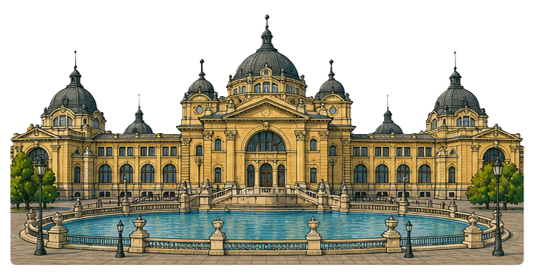
Museum of Fine Arts, located on the north side of Heroes' Square, it houses one of the world's most significant collections of European art.
Kunsthalle (Műcsarnok), the contemporary art hall located on the south side of Heroes' Square.
House of Music, Hungary, a stunning, modern architectural landmark designed by Sou Fujimoto, famous for its "holed" roof and glass walls nestled among the trees.
Museum of Ethnography, a striking new building with a curved, landscaped roof that you can actually walk on for views of the park.
Budapest Zoo & Botanical Garden, one of the oldest zoos in the world, notable for its beautiful Art Nouveau animal houses (like the Elephant House).
Budapest Circus (Fővárosi Nagycirkusz), the only stone circus building in Central Europe, hosting year-round performances.
City Park Ice Rink, in winter, the lake in front of Vajdahunyad Castle turns into one of the largest and most beautiful outdoor skating rinks in Europe.
For more travel tips for first-time visitors about the Museum of Fine Arts, Budapest Zoo, House of Music, click the below links!

The Jewish Quarter (District VII) is famous for its high concentration of religious landmarks, somber Holocaust memorials, and its unique, vibrant "ruin bar" nightlife.
Dohány Street Synagogue (Great Synagogue), the largest synagogue in Europe and second-largest in the world. This Moorish Revival masterpiece features striking onion-domed towers and an unusually ornate interior that includes a pipe organ. In addition to the Great Synagogue, the district contains the Rumbach Street Synagogue (a Moorish-style gem) and the Kazinczy Street Synagogue (a notable example of late Art Nouveau/Secessionist architecture).
New York Café, often called "one of the most beautiful cafés in the world," this lavish neo-Renaissance coffeehouse on the ground floor of the New York Palace was once the center of Hungarian literary and artistic life.
Ruin Bars: The district is the birthplace of Budapest’s ruin bar culture - pubs built in the courtyards of dilapidated pre-war buildings. Szimpla Kert is the original and most famous, while Instant-Fogas is a massive multi-room party complex.
Gozsdu Udvar (Gozsdu Courtyard), a bustling complex of seven interconnected courtyards filled with trendy restaurants, bars, and weekend artisan markets.
Street Art: The district is a "gallery" of giant murals (firewall paintings), including the Rubik's Cube tribute and the "Match of the Century" mural (commemorating the famous 6-3 victory over England in 1953).
For more travel tips for first-time visitors about the Jewish Quarter in Budapest, click the below links!

How safe is Budapest for tourists?
Budapest is widely regarded as a safe and welcoming city for visitors, especially among Europe’s major capitals. It has a relaxed atmosphere, and most tourists explore the city without any safety concerns. As in any large city, it’s simply sensible to keep an eye on your belongings in busy areas such as public transport, markets, and around major attractions, just to avoid occasional petty theft. Using standard travel awareness - like being mindful in crowded places and sticking to reputable taxis or transport options - is enough. Overall, Budapest is an easy and comfortable city to enjoy, with a strong tourism infrastructure and a generally safe environment both day and night in the main visitor areas.
When is the best time to visit Budapest?
The best time to visit Budapest is generally in spring (April–June) and early autumn (September–October), when the weather is pleasant and the city is lively but not overcrowded. Summer (July–August) is the busiest period, especially in central Pest areas like District V, the riverside near the Parliament, and the Castle District in Buda, where long queues and packed streets are common. This is also when popular attractions such as the thermal baths, ruin bars in District VII, and major sightseeing spots tend to be at their most crowded. December is another peak season due to the Christmas markets, particularly around Vörösmarty Square and St. Stephen’s Basilica, which attract large crowds in the evenings. If you prefer a more relaxed experience, visiting outside these peak periods allows for easier access to attractions and a more comfortable pace around the city.
2025 Actual Low/High Temperatures, Rainfall and Humidity in Budapest
Month | Low °C (°F) | High °C (°F) | Rain/snowfall (mm) | Humidity (%) |
January | -4°C (25°F) | 6°C (43°F) | 42 mm | 84% |
February | -6.7°C (20°F) | 8°C (46°F) | 38 mm | 81% |
March | 0°C (32°F) | 14°C (57°F) | 35 mm | 72% |
April | 8°C (46°F) | 18°C (64°F) | 48 mm | 66% |
May | 11°C (52°F) | 21°C (70°F) | 72 mm | 69% |
June | 15.5°C (60°F) | 26°C (79°F) | 68 mm | 67% |
July | 17.4°C (63°F) | 31.9°C (89°F) | 52 mm | 59% |
August | 8.3°C (65°F) | 29.6°C (85°F) | 47 mm | 56% |
September | 14.1°C (57°F) | 23.3°C (74°F) | 46 mm | 63% |
October | 9.2°C (49°F) | 16.5°C (62°F) | 52 mm | 76% |
November | 4.7°C (41°F) | 10.2°C (50°F) | 58 mm | 83% |
December | -0.5°C (31°F) | 4°C (39°F) | 50 mm | 86% |
For more practical tips, read the second part! Click the below link!
Did you know?
We have lots of other posts for you to enjoy!
Click the below links!
See all Gems of Budapest posts: |


